
A Lineage world running on the original client, rebuilt to play in a browser. No download, no install. The items you earn can be yours on-chain — and still swung at monsters.
Nothing is signed or sent until you approve it.
A Lineage world running on the original client, rebuilt to play in a browser. No download, no install. The items you earn can be yours on-chain — and still swung at monsters.
Not a remake or a tribute — the original 2002 client's own art, decoded straight out of its archives and drawn in a canvas.
Every sprite, tile and interface panel is read live from the game's own
.pak archives. The inventory frame you see is the one from 2002,
not a recreation of it.
An unmodified l1j server decides everything — movement, combat, drops, trade. The browser is a client, not a simulation, so the rules are the ones the game has always had.
It runs in any modern browser. No launcher, no patcher, no twenty-year-old executable asking for administrator rights.
Put an item on-chain and it stays in your bag. You still equip it, still fight with it — it simply also exists as something you can sell to anyone, anywhere, without asking a server for permission.
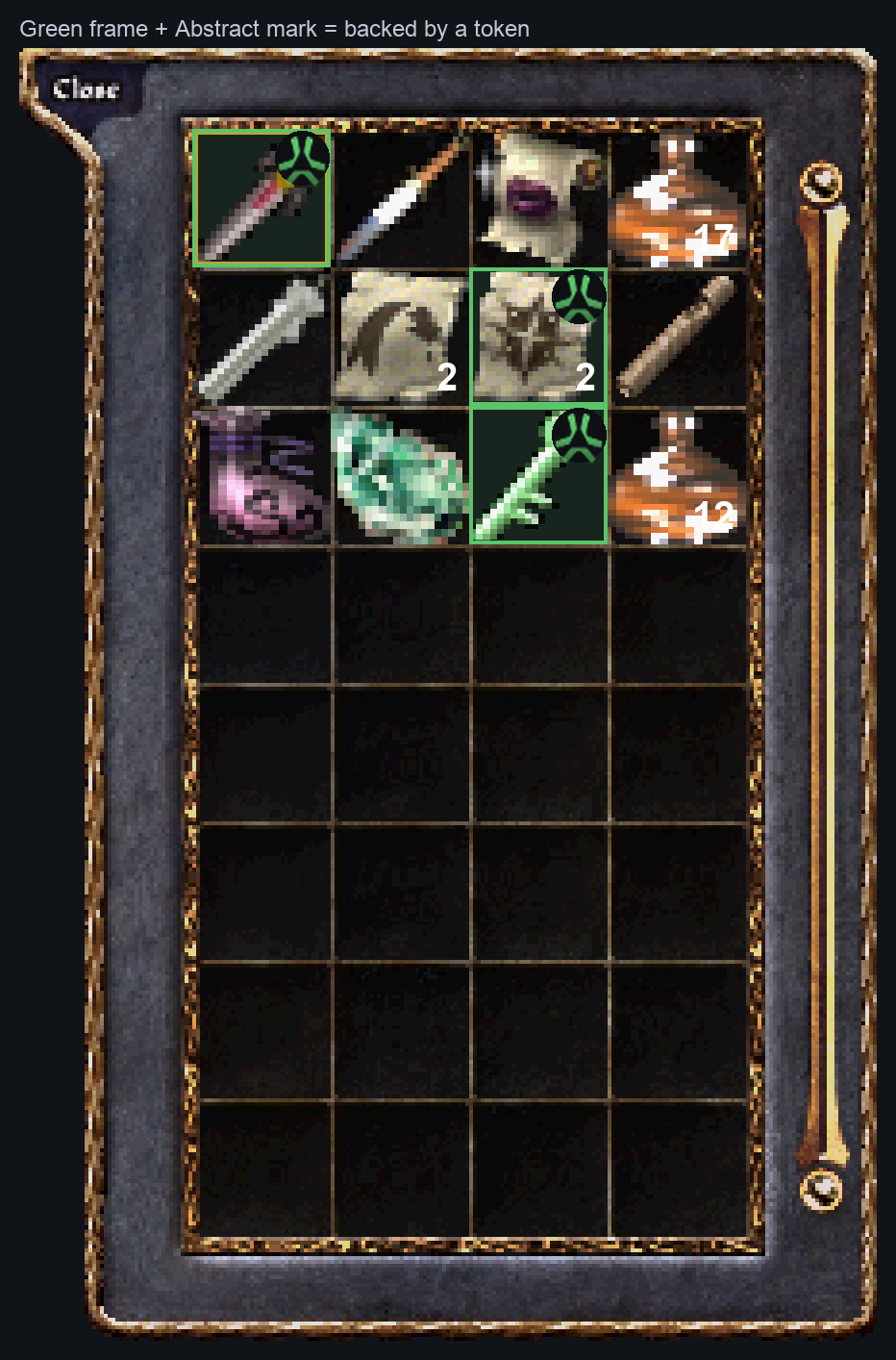
A token-backed item is marked with a green frame and keeps working exactly as before. It is also safe from being dropped or lost on death.
While the token exists, the item trades on-chain rather than in the game's trade window — the same thing cannot change hands in two places at once. Release the token and it goes back to normal trade.
Rendered from the game's own icons, with the stats the server actually resolves combat with — not invented rarity.
A character keeps being played while its token exists — it levels, earns and fights normally, and these cards read the live stats rather than the ones frozen at mint.
One token per kind of creature, drawn with the sprite the game actually uses. 245 of the world's 834 are minted — these are the highest level of them.
Rendered from the live server: real ground, and every character drawn where the world actually has one. Re-taken as the towns change.
Read from the server and the chain when this page loaded. Nothing on this page is a decorative number.
One token for one kind of monster — its real sprite, its real stats, straight from the server's own tables. 245 of the world's 834 creatures are minted.
The idea is simple: hold a creature's token and earn a small bounty in DNR whenever anyone in the world kills that creature. A passive royalty on the hunt. The hard part is making it fair, because monsters are not equally farmable — and the gap is not close.
| Creature | Spawns | Respawn | Kills/hour ceiling |
|---|---|---|---|
| Cruel Snow Tiger (lvl 48) | 612 | instant | 73,440 |
| Cimaera (lvl 39) | 611 | instant | 73,320 |
| Corrupted Skeleton Knight (lvl 55) | 1 | 10 min | 6 |
| Jeb Requie (lvl 70) | 1 | 7 hours | 0.14 |
The most farmable creature is 6,100,000× the least. So the obvious design — pay per kill, scale by level — fails badly. Give the level 70 boss ten times the rate and a Snow Tiger still earns fifty thousand times more. The rarest token in the set would be worthless and a trash mob would be a money printer. Any workable system has to neutralise farmability, not reward it.
1. Each token has a daily bounty budget, set only by the creature's level. Level is fixed game data — it cannot be farmed, inflated or influenced by a holder, which is exactly why it is the only input.
2. The per-kill payout is that budget divided by how often the creature actually dies. This is the part that does the work, and it is self-normalising: a boss's two kills a day each pay a lot, a trash mob's hundred kills each pay a sliver, and both fill about the same budget.
| Creature | Budget / day | Expected kills | Per kill |
|---|---|---|---|
| Jeb Requie (70) | 1.4463 | 2 | 0.781091 |
| Guardsman of Yahee (65) | 1.2287 | 131 | 0.009347 |
| Abyss Ghoul (45) | 0.5471 | 186 | 0.002943 |
| Bandit (32) | 0.2584 | 142 | 0.001820 |
3. The budget is a hard daily ceiling. Kills past it earn nothing. Farming one creature around the clock does not create more DNR — it exhausts that token's budget faster and then stops. Total emission is bounded by the set, not by anyone's effort.
4. A kill only counts if the creature was worth killing. A budget bounds how much DNR exists; it says nothing about who collects it. Without this rule one level 99 character sweeps the low-level maps and takes the whole set's emission in an afternoon, risking nothing. So the bounty scales with the gap between killer and creature: within 5 levels pays in full, 15 levels or more pays nothing, tapering between. A level 99 killing a level 32 Bandit earns zero — collecting that Bandit's budget takes somebody for whom a Bandit is still a fight. Killing something far above your level pays in full; that is earned.
The two rules point the same way. The easy creatures are only farmable by the characters they are meant for, and the rare high-level ones — the ones a strong character can still earn from — carry the largest per-kill bounty.
Live on Abstract mainnet (chain 2741). Every address is readable on the explorer — nothing here asks you to take a screenshot's word for it.
| Contract | Address |
|---|---|
| Denara (DNR) | 0xe08a8a8fd38b7acfc47dcdb90de26be05d039424 |
| Rewards | 0xd5fB8F36289d533941158A4c0B3A472844F4d11B |
| Items | 0x2A13b1aDF2FD77E01FE4FD617Dd9b70cb04cd9d3 |
| Characters | 0x1ce13f0B52590d419d839aa4871Bf88081C23986 |
| Bestiary catalogue | 0x6176FD2681446B1444A15f0226E5C5bC34cBef0A |
| Bundles | 0x35d02Ef89F723e063E909dE0743707f4F275a374 |
| Market | 0xB5CF4085B37A1Ef30BdD9327DEA35f39747Ff8F9 |
This began as a question rather than a plan: could a 2002 Lineage client be made to run in a browser, and could the things you earn in it be made real on a chain without hollowing out the game that gives them meaning? It got answered over a run of evenings and weekends, mostly for the pleasure of finding out.
There is no roadmap and no launch. It may never open to the public. Nothing here is a promise, a sale, or an invitation to buy anything — the tokens exist because minting them was the only honest way to test whether the idea worked, not because anyone should want them.
What is true is on this page and checkable. The contracts are deployed and verified on Abstract, and their addresses are above. The screenshots are rendered from the running server, not mocked up. Where something is only designed — the bestiary bounties, for one — it says so in the same breath as the numbers.
Curious, or think something here is wrong? Both are welcome.